


For market, fair and pop-up days · KamraiDee
Know what a market day really made you.
Booth fee, travel, what sold, what's left. See the profit from the day, not just the cash in the box.
Joining costs nothing. There is no waitlist.
Shops that sell at markets, fairs and pop-ups
What do you sell?






Pick your shop type to see its own page.
Why it helps
Booth and travel are costs. Cash in is not profit.
The cost of the day.
The booth, the travel, and packaging on what you sell. Add them before you count your profit.
What sold, and what did not sell.
Sell-through is pieces sold divided by pieces you brought. What is left is still a count you can see.
The price that covers the day.
Break-even is the sales that cover the cost of the day. It is a guide for the price, not a promise of what will sell.
What you count
Four numbers from the day
Booth
The fee for the spot, whether you made the goods or found them.
Travel
The trip there and back. It is part of the day, not a separate business.
What sold
How many pieces were sold, and the money they brought in.
Pieces not sold
Pieces you still hold. Count them.
Example: one market day (made-up numbers)
What the day left, after the booth and the trip.
40 pieces brought, 30 sold
- Cost of what sold฿1,050
- Booth฿500
- Travel฿200
- Left after the day฿920
- Sold฿2,670
You bring 40 pieces that cost ฿35 each (฿1,400). You sell 30 at ฿89 (฿2,670). The booth is ฿500 and travel is ฿200. The cost of what sold is ฿1,050. Profit on the day is ฿2,670 − ฿1,050 − ฿500 − ฿200 = ฿920. Sell-through is 75%. 10 pieces (฿350 at cost) go home and are not a loss.
Cash in is not profit
Count the day, not a markup on one piece
In this example, profit on the day is what you sold, minus the cost of those pieces, minus the booth and the travel.
With the made-up numbers above, ฿2,670 sold, minus ฿1,050 for the pieces that sold, minus a ฿500 booth and ฿200 travel, leaves ฿920. The 10 pieces that go home still cost ฿350, and they are still yours. This example does not call them a loss.
In this example, ฿920 is left from ฿2,670. That's about 34% of the money that came in.
Free tools
Three free tools for the day. No signup.
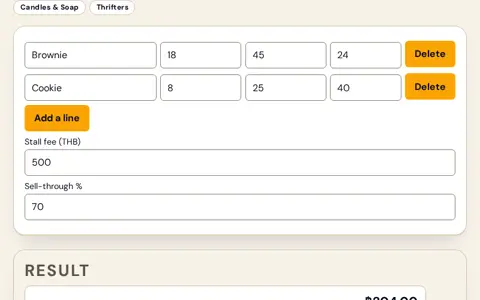 Market stall planner: how much to bring, the stall fee, and a break-even before the market dayHow much to make, the stall fee, and how much you expect to sell.
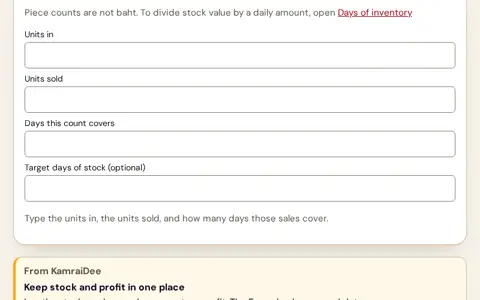 Sell-through: pieces sold compared with pieces you brought, and what is leftPieces sold compared with pieces bought in, and how many days the rest will last.
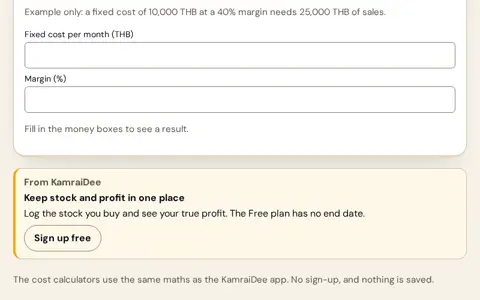 Break-even: a fixed cost divided by your margin. A guide, not a forecastYour fixed costs divided by your margin. A guide, not a forecast.
They need no sign-up and save nothing.
From the blog
Related reading
 Is your busy shop truly profitable?Understanding the true nature of sales vs profitability
 Why 50% markup is not 50% profitYou bought something for 40 baht. You sold it for 60.
 The thing you sell is not one recipePizza base and tomato sauce are recipes you reuse. Cost them once. The Hawaiian pulls them in.
You think you're making money. Are you?
Free to join. Same price for every shop type. See pricing
Joining costs nothing. There is no waitlist.
FAQ
Questions about a market day
Can I log the pieces that did not sell?
The free sell-through tool shows what is left. It does not save. It is pieces sold divided by pieces you brought. If nothing has sold yet, days of stock stays empty. When the stall book is on for your shop, a saved day stores how many you brought and how many sold, and leftover is the difference. Open sell-through
Do these tools save what I type?
No. The market stall planner, sell-through and break-even need no sign-up and save nothing.
What does the market stall planner count?
How much you make or bring, the stall fee, and how much you expect to sell. It shows a break-even before the market day. The cost it uses is the cost of everything you bring, plus the stall fee. It has no separate box for travel. Nothing is saved. Open the market stall planner
How does the break-even tool work?
The sales you need are a fixed cost divided by your margin. The tool calls that cost a fixed monthly cost. Margin stops at 90%. It is a guide, not a forecast. Nothing is saved. Open break-even