

Real cost of pad krapow with fried egg
Understanding the true cost in the plate
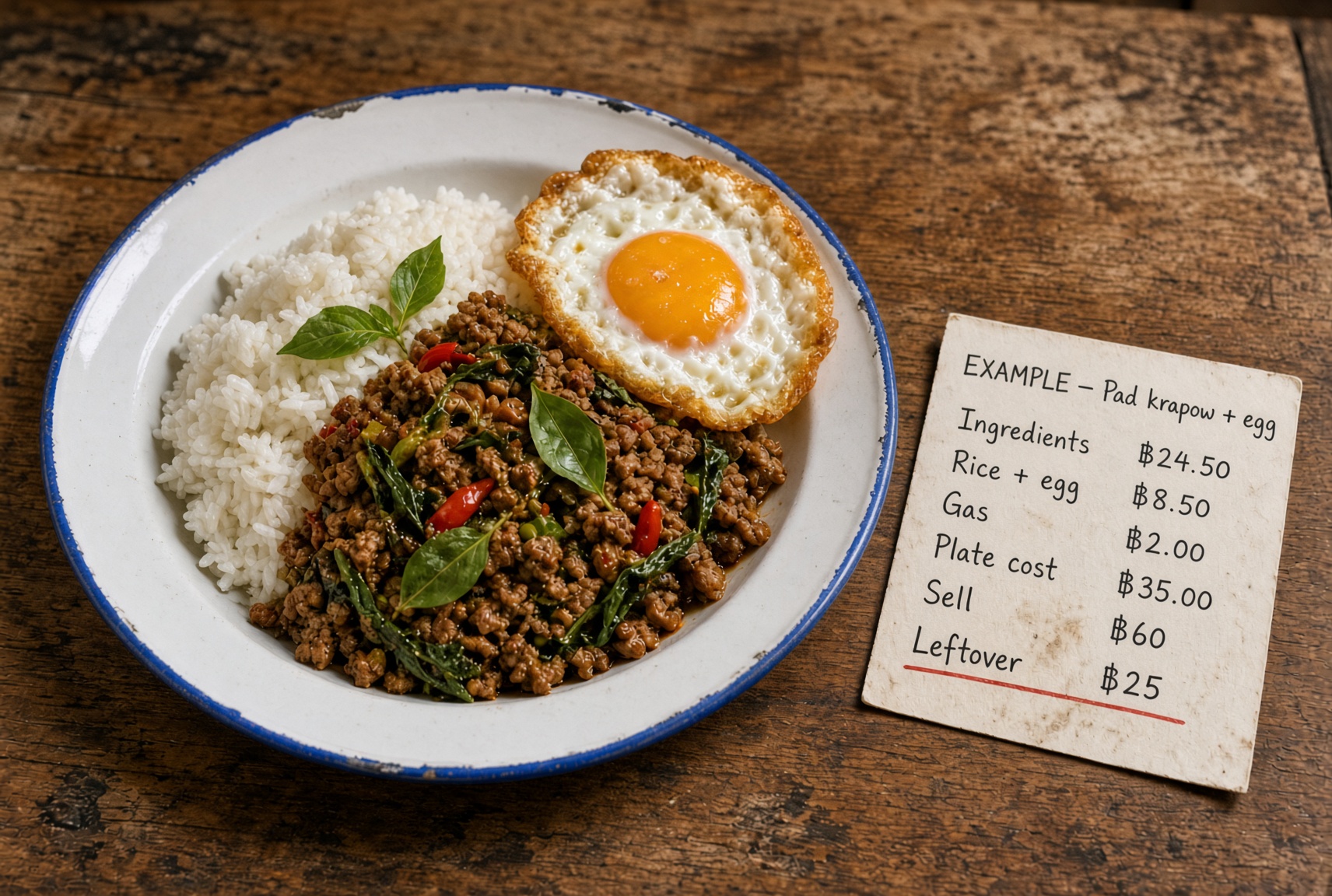
The wok is loud. The egg spatters. The plate leaves in forty seconds. You already know the taste. What most shops do not know is the number on that plate after the pork, the rice, the egg, the sack’s van, the gas, and the box if it goes on a bike.
Pad krapow with fried egg — ข้าวกะเพราไข่ดาว — is the dish Thailand runs on. Office lunch. Taxi late night. The hero on a made-to-order board. Street tags in 2026 often sit around ฿50–฿80 for a local plate, a little more in tourist sois, a little less in a provincial market. The tag is public. The cost is not.
This is the simple version of that cost. How it changes the product you should keep making. How it changes the price on the board. How it changes leftover baht. Then how to price your plate today with the free tools — no signup.
Every baht figure below is a sample calculation, not your shop and not a claim about what anyone “saves.” Change the grams. Keep the method.
In this article
- What “real cost” means on this plate
- A sample plate, line by line
- How the real cost changes the product
- How the real cost changes the price
- How the real cost changes leftover profit
- The same plate on a table and on an app
- How to price it today
- Mistakes that hide the number
- Questions
What “real cost” means on this plate
Real cost is not “pork plus a guess.” It is every baht that had to exist for that one plate to leave the pass.
Sales = what the customer paid.
Cost = what it took to make and hand over that plate.
Leftover = sales minus every real cost.
The queue only measures the first line.
Three layers sit on pad krapow. Mix them and the drawer lies.
- Ingredient cost — meat, basil, chilli, garlic, sauce, oil, rice, egg. This is the line most owners can recite from memory.
- Plate cost — ingredients plus the things that ride with the plate: gas on this wok time, the box and bag if it leaves, a share of waste (wilted basil, a broken yolk you remake, rice that dries in the cooker).
- Shop leftover — plate leftover after rent, power, the helper, your own hours, and the cut if an app took the order.
Food-cost talk in Thai shops often aims near 28–35% of sales for a restaurant plate, sometimes 25–30% on a simple one-plate rice shop. Treat that as a compass, not a law. Your grams and your tag decide.
KamraiDee’s job on this dish is the stall sentence: รู้ต้นทุนจริง เห็นกำไรจริง เก็บเงินไว้กับร้านได้มากกว่าเดิม. Know the real cost. See the real leftover. Keep more of it. Not a lecture on “accounting.” A number you can use before the next lunch rush.
A sample plate, line by line
Imagine a neighbourhood made-to-order shop. Minced pork krapow, one fried egg, a normal scoop of rice. Dine-in tag ฿60. You sell it all morning. The shop feels rich.
First, land what you buy. A sack of rice is not the price on the bag. Pack plus the van is the number that belongs on every gram. That is the whole point of Shipping is food cost. Do the pack on the free Stock unit cost tool. Pack price + shipping. Then one gram.
Sample ingredients on one plate
| Line | Use on the plate | Sample unit | Baht on the plate |
|---|---|---|---|
| Minced pork | 80 g | ฿169 / kg | 13.52 |
| Holy basil | 10 g | ฿40 / kg | 0.40 |
| Bird’s eye chilli | 3 g | ฿38 / kg | 0.11 |
| Garlic | 5 g | ฿75 / kg | 0.38 |
| Fish sauce, oyster sauce, soy, sugar, oil | one wok pass | — | 2.60 |
| Jasmine rice, after sack + van | 200 g cooked-weight scoop | landed sack | 4.50 |
| Chicken egg, size 2–3 | 1 | ฿4.00 each | 4.00 |
| Ingredient cost | 25.51 |
That ฿25.51 is the honest grocery line. It is not yet the plate.
What still sits on the plate
| Line | Baht |
|---|---|
| Ingredient cost | 25.51 |
| Gas + a splash of utilities on this wok time | 2.00 |
| Waste share (wilted basil, a remade egg, cooker-end rice) — sample 4% | 1.02 |
| Plate cost before your time, dine-in | 28.53 |
| Sell on the board | 60.00 |
| Gross leftover on the dine-in plate | 31.47 |
| Ingredient share of the ฿60 tag | about 42% |
฿31 leftover before rent and your hours looks fine. 42% food share is already above the 28–35% band many shops aim at. The plate is not “cheap pork.” The plate is a tight slice wearing a busy costume.
If you only counted pork + rice + egg from memory and called it “about ฿20,” you understated the card by eight baht. Eight baht on a hero that sells 80 times a day is ฿640 that never made it into the story you tell yourself at 11 p.m.
Build this card in the free Cost calculator: pack price plus shipping, how much you use, your minutes, yield. Convert bags and scoops in Units if the sack is kilograms and the wok is grams.
How the real cost changes the product
Once the card is honest, the menu is no longer a list of things people like. It is a list of things that either leave baht or volunteer.
1. The hero can be a volunteer
A volunteer product works for the customer and donates your time. Pad krapow at a street tag that only covers pork and rice is the classic. Customers train you to keep it. You restock it first. You push it on the app photo. Volume then becomes a factory for the wrong thing.
The fix is not “stop selling krapow.” The fix is know whether this krapow, at this gram weight, at this tag, is a product or a volunteer.
2. The meat choice is a different product
Minced pork, sliced pork, chicken, crispy pork, seafood, tofu. Same name on the board. Different card.
| Sample protein on the same 80 g idea | What changes |
|---|---|
| Minced pork | The sample above. Fast. Cheap. Easy to over-scoop when the queue yells. |
| Chicken | Often a little cheaper per gram — until the breast trim and the extra cook time. |
| Crispy pork | Higher pack price. Higher leftover if the tag moves. Same ฿60 tag can wipe the extra. |
| Seafood | A different dish. Do not hide it under “krapow + ฿10.” |
If the board prints one price for every protein, you chose to let the expensive one donate to the cheap one. That is a product decision, not a kindness.
3. The egg is not a garnish
A ฿4 egg on a ฿60 plate is 7% of the tag before it hits the oil. Two eggs is a different SKU. A duck egg is a different SKU. “แถมไข่” on a slow Tuesday is a discount you did not print.
4. Rice is a recipe, not a free bed
The scoop looks free because it comes from a cooker you already lit. The sack had a price. The van had a price. The cooker has gas. A heavy scoop is the easiest silent raise in a Thai shop — you gave away 40 extra grams and called it generosity. Cost the rice as its own line. If you batch a chilli fish-sauce jug or a garlic-chilli paste on Sunday, that jug is an inner recipe. Pull it into the plate the same way a pizza shop pulls sauce. See A Hawaiian is not one recipe.
5. The delivery plate is not the dine-in plate
Same pork. Same egg. Extra box, bag, extra rice that spills, sometimes a spoon, and a platform cut if the ticket came from an app. That is a second product. Give it a second card. Or you will cost the table version and sell the bike version.
What to do to the product
- Cost the hero first — the krapow that already moves — not the new menu idea.
- Split proteins that do not share a cost.
- Split dine-in and packed-to-go if the box is real.
- Weigh one scoop of rice and one handful of pork tomorrow morning. The card is only as true as the hand that plates it.
- Stop restocking a version that only looks busy.
You do not need the whole board today. One plate. The one that left eighty times this week.
How the real cost changes the price
Most krapow tags are set by the shop next door, the price last year, or “looks fair.” None of those ask what the plate costs after the van and the egg.
Feeling-based prices
People still paying ฿60 only proves demand. It does not prove leftover. A packed lunch window trains you that the old number “works.” Busy is not a cost card.
Markup is not margin
You add 50% on a ฿28.53 plate and land at about ฿43. That is a 50% markup and about a 33% margin. Same leftover shape. Different story. If you wanted to keep 50% of the selling price, the tag is ฿57, not ฿43.
KamraiDee prices from margin — leftover ÷ sell — not markup. The public tool uses:
Sell = cost ÷ (1 − margin)
Cap 90%. One decimal is fine. Site default in the product is a 60% margin. Read the short version in Margin, not markup. Then run your number in Price from margin.
Sample tags from the same ฿28.53 dine-in plate cost
| What you meant | Math | Sample tag | Leftover before rent and hours |
|---|---|---|---|
| Neighbour’s board | copied | 60.00 | 31.47 |
| Keep 50% of the tag | 28.53 ÷ 0.50 | 57.06 | 28.53 |
| Keep 60% of the tag (site default) | 28.53 ÷ 0.40 | 71.33 | 42.80 |
| Aim near 30% food cost | 28.53 ÷ 0.30 | 95.10 | 66.57 |
A provincial market stall cannot always print ฿95. A sit-down shop on a main road sometimes can. The table is not a command to raise the board tonight. It is the gap between the story you tell (“we add a bit”) and the leftover you wanted.
Five baht on a plate that sells 80 times is ฿400 before you touch anything else. Ten baht on a ฿60 plate that was never covering the box is the difference between a volunteer and a product. You do not need a new brand. You need a tag that matches the card.
What to do to the price
- Rebuild one sell price from landed cost and a margin you chose on purpose.
- Give the packed-to-go and app versions their own tags if the box and the cut are real.
- Stop using “add 50%” as if it were “keep 50%.”
- Check leftover baht on the same plate in Margin and profit.
How the real cost changes leftover profit
Profit is what survives the day. Krapow attacks it from the sides while you watch the front of the wok.
Contribution is the plate math that matters at speed
Contribution on one plate = sell − the extra costs of that plate (ingredients, gas on this wok, pack, waste you accept, portion of an app cut).
Rent is there whether the plate leaves or not. The pork is not. If contribution is ฿6, a packed shop is a treadmill. If contribution is ฿25, a calmer shop can beat you and go home earlier.
That is why “we were slammed” is not a profit report.
Prime cost sits behind the hero
Food cost alone is not the story. Food plus the people who cooked it is closer. Unpaid family hours make a packed kitchen look cheaper than it is. You can choose not to pay yourself this month. You cannot pretend the minute was free when you set the price for next month.
The Cost calculator asks for your minutes. Put a number in. Even a small one. The tag should still work when a helper stands at the wok — or when you want a Sunday.
Portion drift is a silent discount
The sample uses 80 g of pork. A stressed hand throws 100 g. That is ฿3.38 extra on the sample pork line, every plate, with no new tag. Eighty drifted plates is about ฿270 that left as meat instead of leftover. The customer did not notice a raise. The drawer did.
The drawer is a timing machine
You can be “in leftover” on the card and empty on Saturday night because you restocked the pork for Sunday, the app pays later, or the household took ฿500 from the same tin. Separate three questions: Did this plate leave baht? Did this week leave baht? Is there cash in the tin tonight? The queue only answers “did people come.”
The same plate on a table and on an app
A ฿60 krapow on the table is not a ฿60 krapow in a box on a motorbike.
Standard disclosed GP for many new merchants on GrabFood / LINE MAN / ShopeeFood in 2026 sits around 30% plus VAT 7% on that GP — about 32.1% gone from the ticket before food, box, or bag. Promo windows of 9% or 12% exist. Price the forever rate. Treat the window as extra leftover, not as the floor. Your contract is the only number that is true for you.
| Same sample plate on a 30% GP ticket (VAT on GP included ≈ 32.1%) | Baht |
|---|---|
| Customer pays | 60.00 |
| Platform cut | 19.26 |
| Shop receives | 40.74 |
| Plate cost (dine-in card) | 28.53 |
| Box + bag | 6.00 |
| Leftover before rent and your hours | 6.21 |
You just worked a lunch rush for about ฿6 a plate on the app version. Eighty app plates is about ฿500 leftover — before the landlord. The packed shop was real. The drawer story was the ฿6.
A clean way to think: price the dine-in plate from real cost and margin first. Then price the delivery version as that plate plus pack plus the cut. Do not copy the board onto the app and “see how it goes.” The app will not send a letter when the margin dies.
If you deliver in your own van, that is a different extra job. Use Delivery fee for kilometres, fuel, your time, and a little wear. That tool is not platform GP. Do not mix the two.
How to price it today
Do not rebuild the shop tonight. Price one krapow that already moves.
Step 1 — Land what you buy
Open Stock unit cost. Pack price + shipping on that pack. See one gram of pork, rice, basil. If the supplier sometimes delivers free, shipping is 0. When they charge, type it. Nothing is saved. No signup.
Step 2 — Cost the plate
Open Cost calculator. How much of each pack you use, your minutes, yield. Weigh one real plate once. If a chilli-fish-sauce jug or a garlic paste is reused, cost that inner recipe first. For a tray of the same topping cooked ahead, Many batches keeps the lines honest when you scale. Scale a formula if yesterday’s pot was 10 plates and today’s is 40.
Step 3 — Choose a margin on purpose
Open Price from margin. Sell = cost ÷ (1 − margin). That is what you keep as a share of the tag, not what you added on top of cost. If you have been “adding 50%,” read Margin, not markup before you rewrite the board.
Step 4 — See leftover on that one sell
Open Margin and profit. Cost and sell. Margin is leftover ÷ sell. Cap 90%. One decimal. This is the “is the drawer allowed to be this thin?” check.
Step 5 — Price the extra jobs separately
- Own-van drop across town: Delivery fee.
- Weekend market stall: Stall planner for what you make, the stall fee, and how much you actually sell through.
- More free tools live at kamraidee.com/tools.
Step 6 — Change one tag or one version
Raise a few baht. Print a second price for the box. Tighten the scoop. Stop “แถมไข่” on the app photo. One move. Today. Then look at the drawer on a day that used the new number.
When you want the same math on every plate without retyping, sign up to the book. The tools stay free either way. The upgrade is for the habit of seeing leftover before the rush, not for owning more screens.
Mistakes that hide the number
Using the neighbour’s board as a cost card
They may be volunteering too. Or their rent is older. Or their mother is the unpaid prep cook. Copying a tag copies their leak if you do not copy their cost.
Counting only pork
Rice, egg, oil, basil, the van on the sack, the box. The hero is a stack. Pork is one line.
Leaving shipping in “overhead”
Overhead does not portion itself onto a gram of rice. The sack does. Put the van on the pack. See Shipping is food cost.
Treating promo GP as normal GP
9% and 12% windows exist. 30% plus VAT on GP is the number many shops return to. Price the forever rate.
Counting owner hours as zero forever
You can choose a season where you do not pay yourself. Do not build the permanent tag on that season.
One price for every protein and every channel
Crispy pork is not minced pork. The bike is not the table. One tag for all four is a donation.
Adding SKUs to fix a thin drawer
More items make more busy. They do not automatically make more leftover. Cost the hero. Then decide.
Questions
What should pad krapow with fried egg cost to make?
There is no national official number. Published shop-math examples in Thai often land raw ingredients around ฿18–฿29 and a fuller plate (gas, a little overhead) around ฿28–฿35, against street tags of ฿50–฿80 in 2026. Your grams and your supplier decide. Build your card. Do not borrow someone else’s ฿24 and call it done.
What selling price is “right”?
The right tag is the one that covers the real plate and leaves the share you chose. Use Price from margin. A market stall and a sit-down shop will not print the same number from the same pork.
Is ฿60 too cheap?
On the sample dine-in card, ฿60 still leaves about ฿31 before rent and hours — and already sits at about 42% ingredient share. On the sample app ticket with a box, leftover collapses toward ฿6. ฿60 is not “wrong.” It is unfinished until you know which version you are selling.
Do I put rent on the plate?
Rent does not go into the pork gram the way the van goes on the sack. Rent is a shop bill. Cover it from contribution across the day. If contribution per plate is tiny, no rent formula will rescue the board.
Should I raise the price or cut the scoop?
Either can work. Weigh first. A 20 g pork drift can be a bigger leak than a ฿5 tag. Do one honest plate, then choose.
Where do I start if I have no time?
One pack of pork in Stock unit cost. Then one plate in Cost calculator. Then one sell in Price from margin. Ten minutes. Not the whole menu.
Is this accounting?
No. This is the number on one plate so the price can feed the shop. A licensed accountant still does the books. KamraiDee is for the moment before the next rush.
One plate today
The country will keep eating krapow. Your shop can keep selling it. The only question is whether the plate that leaves eighty times is a product or a volunteer.
Cost one plate. Choose a margin on purpose. Change one tag or one scoop. That is the tiny first step.
Free tools first: Stock unit cost, Cost calculator, Price from margin, Margin and profit. The rest of the shelf is at kamraidee.com/tools. When you want the same math on every SKU without retyping, sign up.